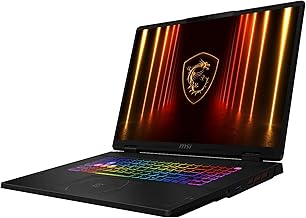
Across six Amazon searches merged into one ranking, the strongest review evidence belongs to the Acer Nitro 5 Gaming Laptop — 4.6 stars from 5,419 ratings, at $799.99. No current-generation machine is close yet: the best-backed RTX 50-series laptop here has 59 ratings.
That gap is why this page keeps two rankings — proven machines first, current-generation ones ranked among themselves below. Sponsored listings, non-gaming laptops and accessories are removed before anything is scored.
Captured 1 October 2026 from amazon.com across six searches · prices change constantly, check Amazon before buying · how this was ranked
#1Acer Nitro 5 Gaming Laptop, 9th Gen Intel Core i5-9300H, NVIDIA GeForce GTX 1650, 15.6" Full HD IPS Display, 8GB DDR4, 256GB NVMe SSD, Wi-Fi 6, Backli
The list above rewards review evidence, which takes years to build - so it favours older hardware. These are the RTX 5060 and 5070 machines from the same search, ranked against each other instead. Far fewer reviews back them, so treat this as "newest worth a look", not "proven".
The specs on each card describe the exact listing linked, not the model in general. The same Legion 5a sells as a 16GB and a 32GB machine a few hundred dollars apart, and the same Victus ships with an RTX 3050 or an RTX 4060 - while the review average covers whichever variant each buyer happened to get.
The GPU line decides frame rates. GTX 1050/1650 is older entry-level silicon, fine for esports titles at 1080p. RTX 3050 is current entry level with ray tracing. RTX 4060/5060 is the mainstream 1080p-to-1440p tier. RTX 5070 and above is high-refresh 1440p and up. A 240Hz screen only pays off if the GPU can actually push those frames.
Why this order looks nothing like Amazon's
Search Amazon for gaming laptop and the first page is mostly noise: sponsored slots, a MacBook Air near the top because it carries forty thousand reviews, a 14-inch office machine whose seller stuffed "gaming" into the title, and six colour variants of the same Legion.
This page starts from the same results and strips all of that out, then ranks what survives on the evidence behind the rating rather than the rating itself. That is why a 4.6★ machine with 5,400 reviews sits above a 5.0★ machine with 22. Twenty-two people agreeing is not the same as five thousand.
What this is not: a hands-on review. Nobody here has benchmarked these machines. It is a ranking of what Amazon buyers actually reported, with the specs of the exact configuration so you can compare like for like.
Common questions
Is a 5-star gaming laptop with only 12 reviews trustworthy?
Not on its own. Twelve reviews is a tiny sample, so a 5.0★ there carries far less information than 4.6★ across 5,000. Every rating here is blended with a neutral 4.2★ baseline weighted at 150 reviews, so a 5.0★ from 12 ratings is pulled down to roughly 4.26, while a 4.6★ from 5,419 barely moves. That is the whole reason this order differs from Amazon's.
Why do older laptops beat brand-new RTX 5070 models?
Because review evidence takes years to accumulate. A 2019 Nitro 5 has 5,400+ ratings; an RTX 5070 machine released this year might have nine. That does not make the old one faster - it makes it better proven. The current-generation models are ranked separately above so you can pick which trade-off you want.
What is the best gaming laptop under $1,000?
Of the machines ranked here, the Acer Nitro 5 has by far the strongest evidence under that figure - 4.6★ from more than 5,400 ratings. The HP Pavilion Gaming 15 and the Ryzen 5 HP Victus also come in below $1,000 with smaller but positive histories. Confirm current prices on Amazon; they move constantly.
Why are there no MacBooks here?
Because they are not gaming laptops, even though Amazon returns them for the search constantly. A MacBook listing carries enormous review counts, so any ranking based on rating strength alone floats it to the top. This page requires a listing to match the search before ranking it at all.
Does a higher star rating mean a better laptop?
Not reliably. A star average measures buyer satisfaction, not performance, and a handful of buyers can push it to 5.0. Ratings also do not transfer across price tiers - a $600 laptop is judged against different expectations than a $3,000 one. Use the rating for consistency and the spec line for performance.
How often is this page updated?
The capture date is shown at the top. Ratings and review counts drift slowly; prices do not, which is why every card links to the live Amazon page rather than asking you to trust the figure here.
How this ranking was built
Sponsored listings removed first, along with brand carousels and video ad rows, before anything is scored.
Listings that do not match the search removed. A title that never says "gaming" is not a gaming laptop, however many reviews it has. This is what keeps MacBooks and office laptops out.
Accessories separated. Cases, cooling pads and chargers are detected by wording, by "for <product>" phrasing, and by costing a fraction of everything else.
Trust-adjusted rating. Each rating is blended with a neutral 4.2★ baseline weighted at 150 reviews - a Bayesian average. A 4.6★ with 5,400 ratings keeps nearly all of it; a 5.0★ with 22 gets pulled to about 4.26.
Review depth. More ratings mean more certainty, counted on a log scale so huge numbers do not completely dominate.
Recent demand. Amazon's "bought in past month" figure where it is shown, log-scaled, as a smaller signal.
Price plays no part. It is not in the formula, so nothing ranks higher for being expensive or for paying a larger commission.
Want this on every search, not just gaming laptops?
This page was built with SortPicks, a free browser extension. Install it and you get the same ranking on any Amazon search: it merges 15 pages of results, strips out every sponsored listing, and re-sorts everything best-rated first.